You know that feeling when a valued team member asks for a meeting with you and starts by letting you know they are handing in their notice? That’s a feeling you don’t want to repeat too often. What can you do in the way that you lead your team and shape it’s micro-climate to avoid it? I’ll share some tips below.
Do you have a good sense of your leadership purpose? If you are not sure what I mean and want to see your leadership career progress, there is a good reason to read on. According to Korn Ferry, leaders with a clear purpose not only reach more challenging roles but also achieve greater leadership tenure (average being 18 years). Below I share other benefits of being clear about your leadership purpose, provide an example with my own purposes, and also provide a step by step guide to help you determine yours.
Are you experiencing any of the following in your team or organisation?
You are losing some of your key leadership talent when it is imperative to retain them
Leaders are leaving because they think their careers have stalled
Leaders are expecting the organisation to make their career happen rather than owning their own careers
Your internal leadership talent isn’t ready fast enough for vacancies meaning hefty costs to buy leaders in
If so, having a deliberate approach to supporting career development for your leaders can help, and while you may not be able to ensure this for the whole organisation, there are things you can do within your team or area of the organisation.
Are you being intentional about giving yourself the best chance to grow in skills, competence and experience or are you holding yourself back? I’m not talking about the obvious ways we can grow like training courses but how we approach our work day to day. I’ve been reflecting on how our ability to stretch ourselves depends on how we manage our comfort zone. A recent snowboarding holiday at Whistler, BC, Canada has provided me with some lessons that might help you if you want to be sure you are giving yourself the best chance of growth.
Following on from my January post, I’ve been reflecting on the positive power of the simple word “No”. Recently, some of the managers and leaders that I have been coaching have been wrestling with finding (or making) time to do the ‘right’ things, in part because they have taken on work for others. This assumes of course that they have determined what the ‘right’ things are – both for their organisation but also for themselves.
In this short blog I’m exploring some considerations for managers and leaders who may find themselves in the same position.
Are you a senior leader who recognises that they need to be more strategic? I’ve recently worked with 3 senior leaders who had this development focus – one as a senior consultant in the NHS, one in a global role in FMCG, and one as a senior director in investment services. They all had two things in common (1) they cared passionately about something (2) they had a huge sense of accountability and responsibility, so much so that they didn’t always know when to say no. These two factors both impacted their ability to dedicate time to strategic thinking because of the way that they focused their time.
If this feels familiar, read on for where to start so that you create the space you need for strategic thinking and focus – it’s not just about what you do, but also about how you think.
Today I’m sharing a seasonal gift from me – a chance to learn from your year and set yourself up for the next one – a reason to pause in the busy time leading up to Christmas and the start of a New Year.
I’m sharing 6 reflection questions for you to select from when you choose to give yourself a much needed moment for you. There’s one for every two months of the year but you can choose to just answer one or two now to close out your year, or perhaps pick one every other month for next year. They work equally well for your professional life or your personal life – you can choose what lens to apply.
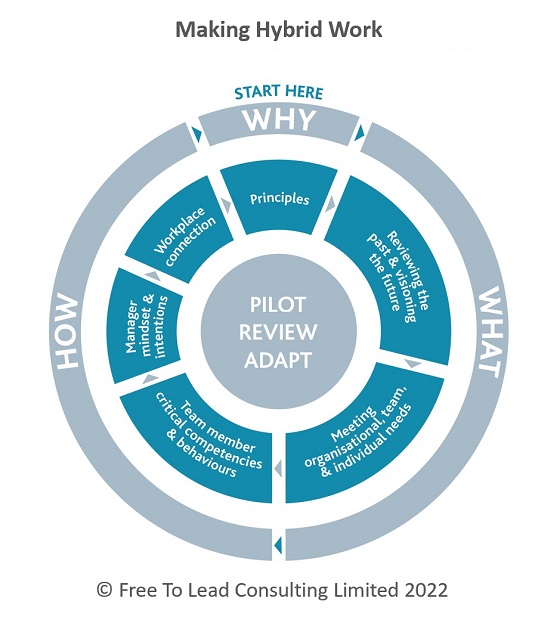
This is the final blog in a series relating to supporting managers in setting up their hybrid team for success. This month I’m sharing to ways to listen to, and view, some key tips for managers related to the model above.
Continuing a series of blogs that aim to support managers of hybrid teams in ensuring their teams are connected, engaged, cohesive and able to perform, this month we focus on connection. Rather than being nice to have, connection is an essential of the hybrid working age. Research from BetterUp explains that it is not just that people have become more isolated, but that companies need stronger connections with and among their people to have the committed, adaptable, resilient, and mentally fit workforce that they need. In their survey more than half said they want and need more connection in the workplace. Read on to understand why connection is important, and what you can do as a manager to encourage and nurture effective connection.
Over the last few months, Geri McKenna and I have shared a number of blogs related to ensuring your team is working effectively in a hybrid way. This month, we are focusing on considering your mindset as a manager and will share some thoughts on what mindset will best serve you as a hybrid team manager so that you intentionally support your team and act as a role model.
Let’s start with what, if any, assumptions are you making about hybrid working?