
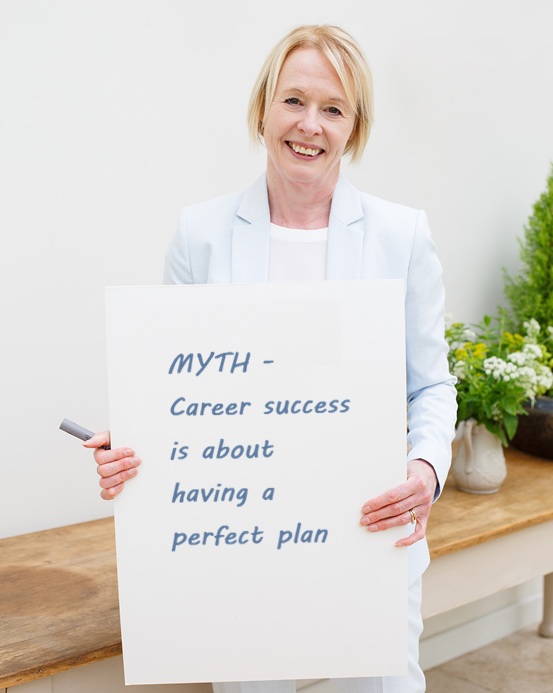
The Myth
I am often surprised by how many coaching clients tell me they believe they should have a detailed career plan that maps out every step to a future role. They feel they ought to know exactly where they are heading and how they will get there. The reality is that this belief is not true. It is a myth. And it is a myth that often stops people from having any career intentions at all because creating a perfect plan feels too difficult.
The Reality
When I look back at my own career, it is clear that I did not have a step by step plan mapped out. I went from a technical individual contributor role to a technical team leader role, then into a hybrid tech and HR role, then into HR generalist work, then specialist work, then OD consulting, and finally into being an executive coach, leadership development specialist and facilitator. Three of my roles were made redundant along the way. Yet it all worked out in the end. I didn’t have a perfect plan, but I did stay intentional and open to opportunities.
What helps?
Most careers are shaped by a mix of intention, experimentation and chance conversations. Some of your biggest moves may come from being in the right place at the right time. You can increase the chances of that happening by putting yourself in environments where informal conversations can take place and by staying curious about what might be possible.
Although the need for a perfect plan is a myth, having some intentionality and something to guide your decisions is helpful. I encourage people to consider the overall life they want for themselves at some point in the future and how their career might play into that or enable it.
It also helps to find the sweet spot between roles that organisations will need given predicted future trends and work that gives you meaning. It does not have to be your absolute passion. That is another myth. Your passion may be in an area where there is no work or you may not have the right conditions such as a great culture, a good manager or career prospects. If those conditions are missing, passion can fade. What matters is finding work where you can play to your strengths or build strengths while enjoying much of what you do.
To be intentional about your longer term career, it helps to have a sense of the direction you are moving in. Rather than needing to aspire after a specific job title or mapping out every step, it is more about choosing a long term direction that aligns with your life vision, values, career drivers (e.g.autonomy, purpose, mastery or security), and your strengths. A long term career goal gives you something to grow towards. It helps you make intentional choices rather than reactive ones and it becomes a compass for deciding which opportunities will genuinely move you forward.
A 10 to 15 year career goal can take different forms:
- Role based – E.g. “I want to be a Director of…”
- Impact based – E.g. “I want to be shaping strategy and influencing decisions at a senior level.”
- Identity based – E.g. “I want to be known as a trusted expert and leader in…”
There is no one right answer and your direction may change. Mine certainly did. Once I recognised that I was interested in how to manage people well, motivate them and enable them to thrive, I focused on building my capability there and gaining experience. This led me to become interested in doing this on a wider scale through HR. From there, once I had received coaching myself as a leader, I became passionate about how coaching can enable people to fulfil their potential in a way they had not appreciated. I undertook a masters and eleven years ago set up my own business. I had a goal at each stage, but that goal changed based on my experiences and learning. One thing that did not change was my intentionality to go after what I wanted.
If you recognise yourself in the myth of needing a perfect plan, remember that clarity often emerges through action. You do not need to know every step. You only need to know enough to take the next one.
Key guidance to take away
- You do not need a perfect plan. Most careers grow through intention, experimentation and chance conversations.
- Some intentionality helps. A sense of direction supports better choices than reacting to whatever comes along.
- Consider the life you want in the future and how your career can enable it.
- Look for the sweet spot between organisational needs, meaningful work and your strengths.
- A long term direction can be role based, impact based or identity based.
- Your direction can change as you learn and gain experience.
- Clarity often emerges through action. You do not need to know every step to take the next one.

Leave a Reply