
Image by Pintera Studio from Pixabay
Wherever you are in the world as you read this, there is a strong likelihood that your working life is different from how it was 5 months ago. We are hearing a lot about the concept of a ‘new normal’ and yet that implies some stability; at the moment, it feels as if the ‘new normal’ is a continuum where the reality of our context for work and life changes a little with each month that passes.
Given this transitionary state, how can we best lead our teams, and how can we, as team members, best lead ourselves in order to function well in our performance and for our mental well-being?
I coach leaders, professionals, and teams and having reflected on key themes arising from my coaching in the last 5 months, I’m sharing some ways that leaders and professionals are helping themselves at this time. This month I’m focusing on team members. Next month I’ll be writing for team leaders.
What transitions are you experiencing?
To help yourself to adapt to your current work situation and to continue to adapt, consider the Transition model of William Bridges. He explains that while change is something that happens to us, it is the internal transition that happens to us psychologically and emotionally that we need to focus on. While a change can happen quickly, our internal adjustment to the change can be slow. We firstly experience an ending of something which can mean loss of control, loss of identity and of how things were. We then move to a neutral zone where we are trying to reorient from the old to the new until finally we step into new beginnings.
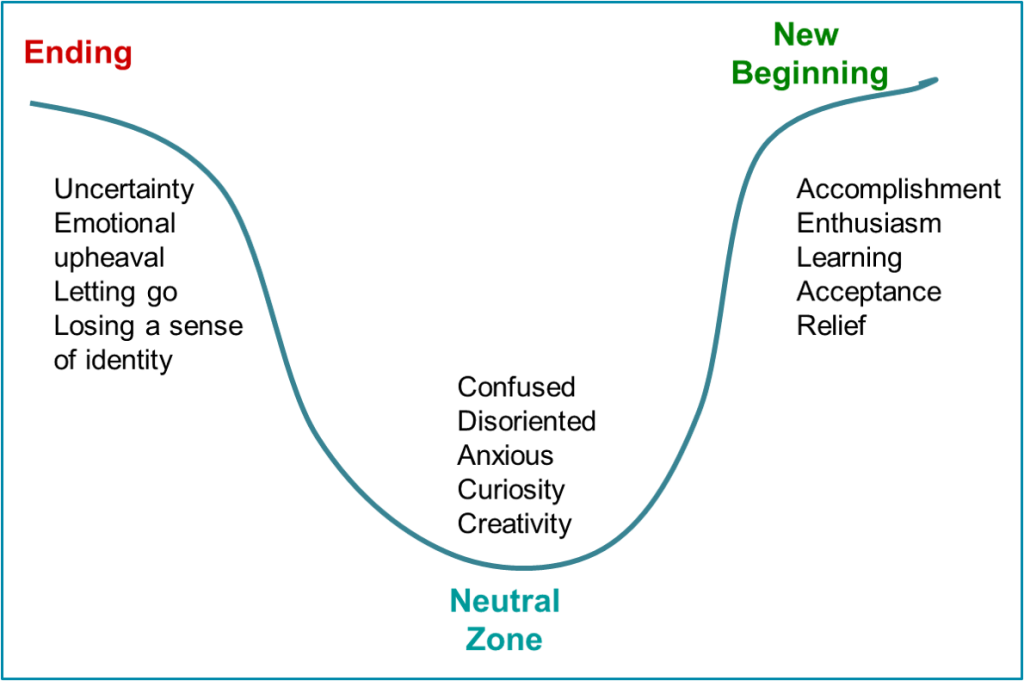
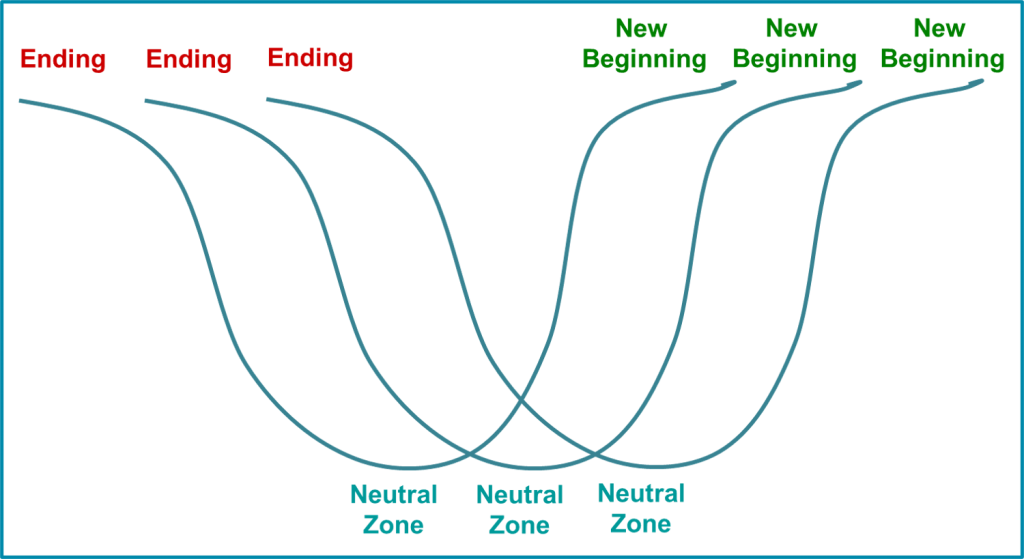
Currently, it is likely that these changes and transitions are layered on top of each other so that we might have got to feeling positive about one change as we reach a new beginning while dealing with the ending of something else. For example, if you have been working at home with remote connections where normally you would be in an office, you may have worked through the transition related to how you feel to be at home and are starting to recognise the advantages this offers you. However, you may also now be being asked to return to the office for a day a week for key activities and find yourself with some concerns and uncertainty as you work through a new change.
So how can you help yourself? Here are my 5 tips:
- Be kind to yourself – recognise that we all experience change differently and that we are human with feelings that can surprise us. Check in with yourself each morning to assess how you are feeling and practice being more emotionally aware and accepting. For tips, see my previous blog Tapping into your emotional detective
- Manage your mindset – consider how you are thinking about your context and determine if it is helping or hindering you. We have a choice about our thinking. For tips on managing your mindset, take a look at my March blog, Navigating uncertainty through mindset.
- Self-motivation & management – even those most self-disciplined of us can find it tough to keep focus when working from home for the first time. Even if you are an old hand at remote working, adding the strangeness of the Covid-19 reality means concentration can be elusive. Go back to the basics of personal effectiveness. I’m summarizing this with 5Ps: Prioritise, plan, punctuate, perform, pat. Start the week considering what’s important and what urgent (Covey’s grid can help here). From these, prioritise the first 3 things you will do in the week. Then plan how you will address the first today. Set yourself realistic time slots for working and punctuate the working time with breaks to keep yourself fresh (at least 10 minutes every 90 minutes…do some flights of stairs, get a drink, try some box-breathing). This will enable you to perform when you are working knowing that you are going to take a break in just 60-90 minutes. Finally, pat yourself on the back at the end of each working block where you’ve made progress. Your self-management habit just got a boost or refresh.
- Being proactive with relationships – if you are working at home and were previously in an office or out and about for work, you will have much less ‘chance’ opportunities to connect with people just because you are in the same place at the same time, at least in person. It is easy for us to become very transactional and task focused when working at home, only connecting with others because work requires it. Aim to ensure that any on-line connection is also an opportunity to build the relationship and if you don’t have a task-based reason to connect, why not just check-in to see how someone is? For more relationship building tips, see my earlier blog.
- Conscious work-life balance – I’ve noticed clients who are newly working from home taking advantage of their time gained from not commuting to ‘get on top of work’. That’s fine if it is a conscious choice, and not at the cost of something more important. Alternatively, perhaps you only need half of that time or less for work and could use it at points during the day to get outside, or to stretch and take a drink, or to connect with someone etc. The point here is to check that you are not drifting into habits that don’t serve you. Make conscious choices that help you.
Finally, while these 5 tips can support you as you navigate overlapping transitions, it also helps to take stock. Given that each month feels different at the moment, reflect on a monthly basis about what worked last month that you want to keep, what needs to be discontinued and what’s possible next month. If you try any of these tips, let me know how it went for you.

Leave a Reply