
Do you ever feel like it would be useful to share something about yourself with someone else in the workplace but worry about how it will land? While we always have a choice about what to share with others, sometimes, even when it could help us we don’t feel we can.
This can be because we fear being vulnerable and may be influenced by how safe we feel with the person we are talking to. Even when we do feel safe with the person, we can still shy away from sharing but it can help if we understand ourselves and see sharing as a way to be authentic.
Recently, I was taking part in an end of coaching programme review with my coaching client and her manager.
As part of the session, my client reviewed her coaching focus areas and shared how she had addressed them and the progress she was making. She shared some information about thinking and behaviours that had been holding her back and did this in a very transparent way which was in part because of the trust between her and her manager. What also helped was the fact that she had identified transparency as a personal value.
She wanted to be true to her values and had considered how she wanted to show up at work every day. My feeling was that this helped her to share very openly what she had learned about herself and how she was behaving differently.
She was also practicing treating life as an experience rather than a performance; as someone who had perfectionist tendencies, she would previously have found it hard to share her struggles. Now, with a wish to be transparent, and a realisation that the meeting with her manager was an exploratory conversation to experience rather than a ‘show and tell’ where she needed to perform she was able to be more vulnerable.
There are real benefits to being vulnerable including building trust, bringing deeper, more meaningful relationships, and encouraging others to be open in return. I felt that my client’s manager responded with greater openness as a result of her sharing.
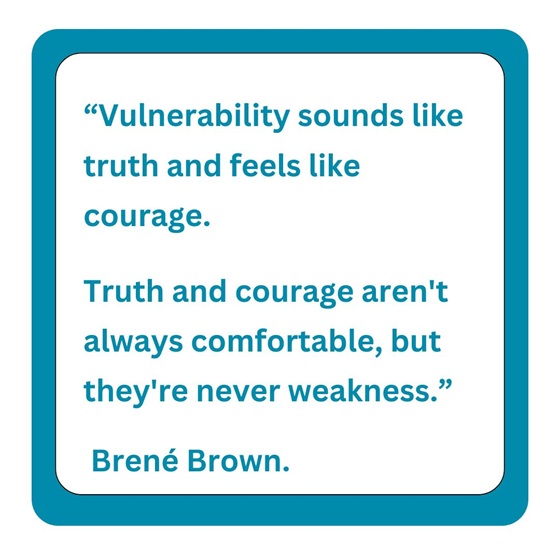
As Brene Brown said in her book Daring Greatly, ‘Vulnerability sounds like truth and feels like courage. Truth and courage aren’t always comfortable, but they’re never weakness.’ It can help us to continuously remind ourselves that being vulnerable is not showing weakness but in fact showing courage.
To become more comfortable expressing vulnerability, it can help to:
- Challenge negative beliefs about vulnerability- do you have evidence? Have you seen others be vulnerable to positive effect?
- Start small – in low stake situations you can demonstrate ‘micro-bravery’ to make a start and build your own evidence that being vulnerable is not only ok but can have a positive impact. We may not get it right every time but we’ll get better. As Brené says in her book: “The willingness to show up changes us, it makes us a little braver each time.”
- Express your feelings – feelings are data – acknowledging them and expressing them to others can help to create a more honest connection
- Ask for help – this shows when you know you can do better with support than you could on your own and can strengthen relationships – think about how you feel when someone asks you for help – it often makes us feel valued
- Share your own experience and what you’ve learned from it as a way to help others
How comfortable are you with being vulnerable? Which of the 5 tips might support you to further embrace vulnerability so that you can benefit from deeper, more meaningful relations

Leave a Reply