

“Snakes and Ladders” by jacqui.brown33 is licensed under CC BY-SA 2.0.
Are you someone who has taken roles when they appeared in front of you or do you have a more planned approach to your career?
I was coaching a senior director recently who realised that she had more or less just taken roles that were offered to her because they seemed good opportunities at the time… and she has done very well from it.
However, now that she is approaching the latter stages of her career and thinking about how she’d like to invest the last 5 to 10 years she can see that she could have set herself up better for the next stage with some more selective role choices along the way.
So how could she have done that?
If you want to have a career that is fulfilling, AND prepares you for the future you want to have both professionally and personally, a future-back approach works best. Taking the time to consider yourself a fair way into the future and what you would envisage you would like your life and work to be like, you can then consider what it might take to make that happen.
This is not about job titles.
It IS about considering how many roles you might realistically have between now and then, and how you can use each of them to build your skill set, network, expertise and experience in different ways to bridge the gap between the person you are today and the person you’d need to be for the future you want.
This more curated approach frees you up from purely chasing titles and pay-rises (although these may be nice along the way) and instead helps you consider what you’ll learn and how you will grow.
Sometimes a side-ways move, or even a downwards move can be worth it to enable the career and life you want – imagine it a bit like snakes and ladders … you have a snake take you down a row on the board but then catch a ladder that takes you 3 rows up.
This happened to me when I left a global role in an organisation to join a company where I felt the culture was a better fit for me and there would be greater longer term prospects. I joined in a local UK team role but within a year I had moved to a more senior position and within 2 more years to a larger global role with much more opportunity for growth.
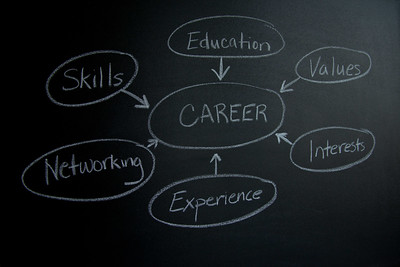
“Career-Mind-map-Chalk” by flazingo_photos is licensed under CC BY-SA 2.0.
But what if there aren’t any roles being advertised for the opportunity that you think might suit you next?
Well, this is probably not the question to be asking.
If you ask yourself instead, ‘given my longer term aim, what experiences and skills do I need to get from my upcoming roles?’
And then…
“Who do I need to speak to so that I can be considered for opportunities that will provide me with these experiences and skills?”…
… you will then be building a career network who you can tap into to talk about upcoming opportunities so that you are creating more possibility rather than being dependent on what might be out there but not necessarily suitable.
So, in summary, if you’d like to move from a career approach that’s more of a happy (or unhappy) accident to one that is carefully curated, here are 3 steps to support you:
- Consider your professional and personal longer term vision and what skills and experiences you need to acquire over time to get there
- Start to build your career network -the people that can look out for experiences for you, who can connect you to other people, and who need talent in their pipeline
- Be open to a variety of next roles rather than just a title and pay rise – consider any role that helps build your longer term set of experiences and skills, and that you’ll find engaging
What’s your first step from here?
Happy curating!

Leave a Reply