
Image by Gerd Altmann from Pixabay
Are you in the first 5 years of your career? Are you already focused on moving into a leadership role in the future? Have you considered the best development focus to give you a greater chance of success in the longer term?
I must admit, in my early career, while I quickly worked out I wanted to help other people thrive, I didn’t know what would help me be successful in my career in the longer term – it’s not something you get taught at school, college or university. If either you are thinking of how to best shape your career development or you have early career stagers in your own team that you could share this with, read on for tips.
In the early stages of my career I focused on trying to do a good job – to fulfil what was expected of me to the best of my abilities and to look for opportunities to learn and grow in my professional skills. I measured my success quite a bit on whether I would get a promotion or a salary rise. And I understand why that’s important to us in early career –both the focus on honing our skills and shoring up our finances. That’s ok .. and yet it would have probably helped me to also be aware of other key areas to develop that would lead to longer term success and I was reminded of that this week.
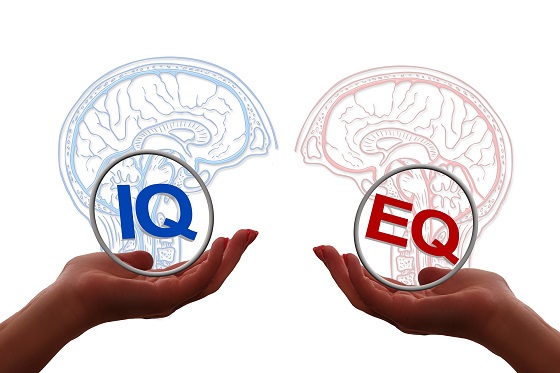
When coaching a young Indian manager this week, he shared with me some differences about success factors for a career in India versus anglo-american cultures; for one, in India ,if you have a great educational pedigree, ‘a great brain’, you are automatically highly thought of and respected in the workplace and likely to progress. We talked about how it can be helpful to consider that, as a leader, IQ gets you in the door. It is EQ however that accounts for nearly 90% of what sets high performers apart from peers with similar technical skills and knowledge.
Research has found that individuals with strong leadership potential also tend to be more emotionally intelligent, suggesting that a high EQ is an important quality for business leaders and managers. Emotional Intelligence is your ability to sense emotion in yourself and in other people and to use that awareness to guide your behaviour appropriately and to manage relationships effectively.
How can we develop our EQ?
Developing EQ starts with our own self-awareness. Focusing on how we feel and being able to identify that is a good first step. Using an emotions wheel can widen our emotional vocabulary which in turn can help us to regulate our emotions more effectively so that they don’t burst out in a way that may have unhelpful consequences.

Practically, when working with early career leaders, I encourage them to take brief notes as they notice their emotions – what was the situation, what emotions did they feel, what were the thoughts behind the emotions, what happened. What might the emotion be telling them? Is there anything as a result that they need to do? It can help them to be more of a ‘participant-observer’ in a situation so that they are noticing what is happening and then have more opportunity to pause momentarily to manage their emotion and choose a helpful response.
The real power of EQ comes when we consider our relationships with others – which is how business gets done day in day out. Key components of emotional intelligence that can help us here are empathy and open-mindedness. To get better at empathising, take time to really listen to what someone is saying, asking clarifying questions if needed and summarising to ensure understanding. Imagine you were the person sharing what the other person has shared. How would you feel? What would you be thinking? This can help you gain a greater connection (although be aware that the other person may be feeling differently from you). Open-mindness is about suspending judgement and being curious. It can help when you are unsure of another person’s motivations in a situation to assume positive intent .. ‘why would a positively intentioned person say or do what this person has done’ and to then respond accordingly.
As team leaders, simple ways to build greater empathy and understanding of team members (which can in turn enable more effective relationships) include:
- In one-to-ones, practice the 80-20 rule – the team member speaks for 80% of the time and you speak for 20%
- Make it ok for people to say how they feel and be specific. If you ask a team member how they are, and they say ok, ask them to expand on that .. what leads to that response? What’s good? What’s not so good?
Finally, if you manage early career leaders, the next time one comes to you asking how they can further develop, consider if EQ might be the best focus area. If so, how can you support them to develop their EQ further? How are you role modelling that this is important?

Leave a Reply